
Different Types of SEO: A Complete Guide With Practical Examples
Publish On: Mar 21, 2026Author: Sakshi
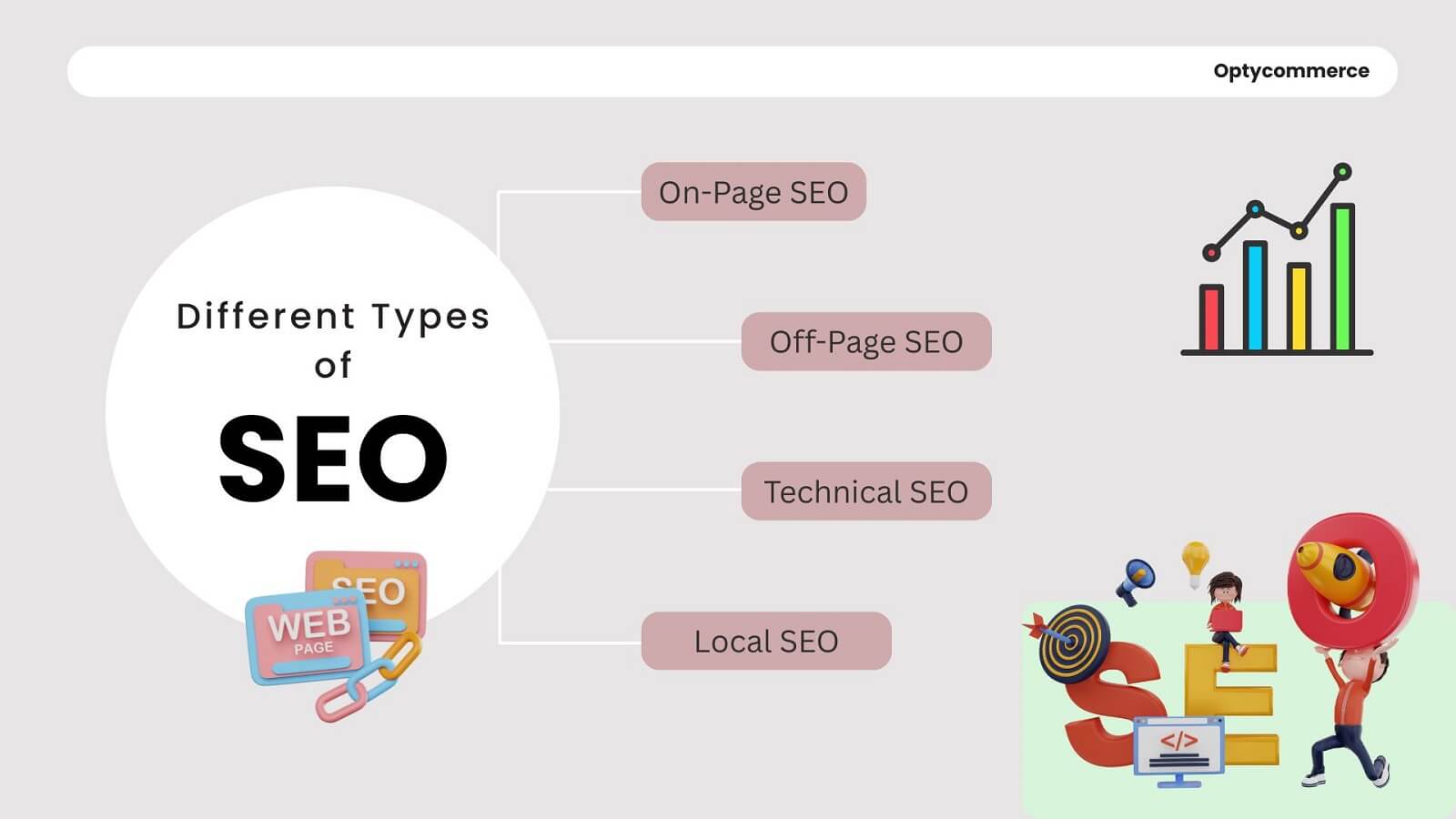
The online world is quite dynamic, and to stay in the market, all one needs is a SEO friendly website. Search engine optimization is one of the most effective ways to grow your website’s visibility and attract the right audience online. But it is not just one strategy - there are different types of SEO that work together to improve your rankings on search engines results pages (SERPs). In this guide, we will explain the different types of SEO, including on-page SEO, off-page SEO, technical SEO, and local SEO, with simple and real-world examples. Understanding these SEO types will help you build a stronger strategy, improve organic traffic, and make it easier for people to find your website through search engines.
What Is SEO?
SEO refers to the art of making your website more visible in search engines such as Google, bing, yahoo ect. It aims to generate organic (non-paid) traffic. However, since Google considers more than 200 factors when ranking, your site optimization will need to be comprehensive.
What Are the Main Types of SEO?
In most cases, the main types of SEO in digital marketing can be separated into three major pillars: On-page, Off-page, and Technical. Nonetheless, with the development of search, specializations such as local SEO have become essential across industries.
1. On-Page SEO:
It refers to the optimization of your website to boost its ranking. This definition includes the text you write and the HTML source code.
Elements of On-Page:
- Meta descriptions and Title tags
- Header Tags (H1, H2, H3)
- Keyword optimization
- Internal linking
- Image alt text
Examples:
When you are writing a blog post on the keyword "leather boots," On-page SEO will ensure that the main keyword appears in the title, that there is a clear H1 tag, and that you link to other similar pages on your site (such as a Leather Boot Care page).
2. Off-Page SEO:
It involves actions conducted outside your website to boost your ranking. The goal is mostly about creating trust and power.
Elements of Off-Page:
- Backlinks (links of other websites to your sites)
- Brand mentions
- Social media promotion
Examples:
A popular fashion influencer refers to your product page in his article. This backlink tells Google the reliability of your site. It is a standard SEO methodology that must not be neglected.
3. Technical SEO
Technical SEO involves ensuring the search engine can crawl, interpret, and index your website without issues. It concerns the back-end design of your site.
Elements of Technical:
- Site speed (loading time)
- Mobile-friendliness
- XML Sitemaps
- Structured data (Schema markup)
Examples:
Compressing your images to have your pages load at a faster rate, or resolving a 404 error page. If Google is unable to crawl your site effectively, then you will not rank regardless of the quality of your content.
4. Local SEO
Local SEO is essential in businesses that have a physical location or those that cater to a definite geographic region. It helps businesses appear in "near me" search results for queries.
Elements of Local:
- Google Business Profile optimization.
- Name, Address, Phone Number consistency.
- Local citations and reviews
Examples:
A coffee shop in Chennai that optimizes the query of coffee shops in Chennai and works on their Google Business Profile to be included in the map pack.
Other Specialized SEO Types
In addition to the four core ones, there are special platforms and types of content that require special SEO techniques. Here is a deeper look at some of the specific types of SEO with examples that are relevant to a contemporary webmaster.
E-commerce SEO: This involves the optimization of product pages for transactional intent. Unlike the blogs, e-commerce sites have to deal with thousands of products and copy content. One of the practical applications of this SEO tool is to use Product Schema markup such that these attributes are used to display the prices and reviews in the search engine results directly, which boosts the number of people who will click on the search engine results.
Shopify SEO: In case you are using Shopify, you face certain constraints. Shopify SEO is editing robots.txt to regulate crawl budget and control URL structure in case of parameter-based duplicates. One of them is to make sure that your canonical tags are properly configured to avoid product pagination problems.
WordPress SEO: WordPress is very flexible, and this is owing to its use of plugins. WordPress SEO is based on the use of such plugins as Rank Math to create XML sitemaps and manage the meta tags. One of them is to utilize an SEO plugin that will automatically compress images and deliver them in next-gen formats for faster loading.
Content SEO: It is a branch of On-Page SEO but is entirely strategy-oriented. It involves development of content hubs or pillar pages on a core topic. As an example, when you sell cameras, you may develop a pillar page that talks about "Photography Tips" and links out to cluster articles on "Lens Types" or "Lighting" and develop topical authority.
Image SEO: The images are capable of generating massive traffic. Image SEO is more than alt tags; it also includes file size, descriptive file names like red-leather-boots.jpg vs. IMG_540.jpg. The second instance is the application of lazy loading, whereby images will not load before a user scrolls to them, and this will save on page speed.
Video SEO: YouTube is the second largest search engine, and Video SEO is vital. It involves creating video sitemaps for Google. An example of this is placing a video on a product page and tagging it with the VideoObject schema that causes Google to show a video thumbnail beside your listing in SERPs.
Mobile SEO: Mobile SEO is a prerequisite since Google indexes on mobile. It makes your site responsive. A good Mobile SEO strategy is to have a responsive font size that allows one to read the text without zooming and also allows the pop-ups to be easily closed on the small smartphone screen.
Final Thought
Understanding the different types of SEO is like putting together a puzzle. You can't skip On-page SEO to focus on Off-page SEO, and you can't skip SEO techniques to focus on Content. To have a successful digital marketing plan, you need to find a balance between all of these things.
FAQ
1. What are the main types of SEO?
The main types of SEO are On-Page SEO, Off-Page SEO, and Technical SEO. Local SEO is often considered the fourth important type, especially for businesses with physical locations.
2. What is the difference between On-Page and Off-Page SEO?
On-Page SEO focuses on elements you control on your website such as content, keywords, headings, and internal links. Off-Page SEO focuses on external factors like backlinks, brand mentions, and signals that build your website’s authority.
3. Is Local SEO only for small businesses?
No, Local SEO is not only for small businesses. Large brands and companies with multiple locations also use Local SEO to appear in search results for specific cities or regions.